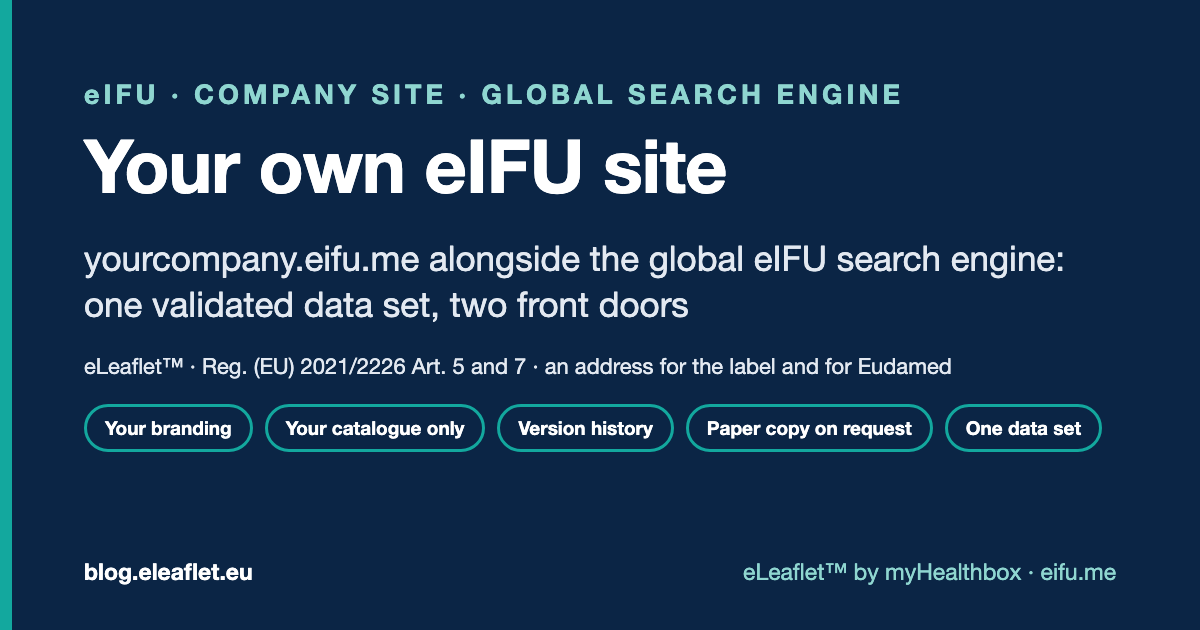
Manufacturers who move their instructions for use online face a choice that is really a false one: publish on a large, well-indexed eIFU search engine where clinicians already look, or run a dedicated site under the company's own name that an auditor, a distributor or a notified body can be pointed to. eLeaflet™ now offers both from one validated data set. Your documents appear on the global eifu.me search engine and, at the same time, on a site dedicated to your products at yourcompany.eifu.me. Update once; both are current.
Why two front doors
Each address serves a different reader.
The global search engine (eifu.me and, for medicines, myhealthbox.eu) is where healthcare professionals go when they have a device in their hand and a question. It is indexed by search engines, searchable by product name, catalogue number, UDI-DI or GS1 identifier, and it already hosts over 3 million official documents from 90 countries. A professional who finds your IFU there finds everyone else's too, which is precisely why they use it.
Your own eIFU site at yourcompany.eifu.me is the address you print on the label, register in Eudamed, give to your notified body and put in your technical documentation. It shows only your products, under your name and logo, with your contact details for paper-copy requests. There is nothing else on it to confuse a user, an auditor or an inspector.
Until now, having both meant two publications, two version histories and, sooner or later, two different versions of the same document. That is the risk regulators care about: Article 5 of Regulation (EU) 2021/2226 requires every issued version to remain available with its publication date, and Article 7 requires a stable address. Two systems make both harder.
One data set, shared
With eLeaflet, the two sites read the same records. When your regulatory team approves a new revision in the editor (with e-signature and a full audit trail), the new version is published to the global search engine and to your dedicated site in the same operation. Previous versions stay available on both, with their dates. The paper-copy request reaches the same address from both sites, and a subscriber to a document is notified of a new version whichever site they used. You never choose which site is the master, because there is only one.
This matters beyond tidiness. The eIFU URL you submit to the Eudamed UDI database under Article 7(3) of the amended implementing regulation must remain valid for the retention period, 10 or 15 years. A dedicated address under eifu.me is maintained by us for that period; it does not depend on your corporate website being redesigned or your IT provider changing.
What a dedicated site includes
- Your branding: name, logo and colours on
yourcompany.eifu.me. - Your catalogue only: products, variants, markets and languages you publish.
- Search by product name, reference (REF) or UDI-DI; the QR code or GS1 Digital Link printed on the pack resolves through the myHealthbox resolver to the right product and document.
- Every language you have published, with the language information required by Article 7(2) of Regulation 2021/2226.
- Complete version history with publication dates, and the version that applies to a given production lot.
- A free paper-copy request on every document, delivered to the address you define within the response time you set (1 to 7 days), and an update subscription with double opt-in.
- The same validated infrastructure as the global site (EU GMP Annex 11, FDA 21 CFR Part 11 evidence available on request), the same uptime and security measures, and the same GDPR posture.
Fully managed or self-managed
Both sites can be run in either of the two eLeaflet service models. In the managed model, you send us the approved documents and we publish, version and maintain them. In the self-managed model, your team uses the eLeaflet editor to upload, approve and publish, and the two sites update automatically. Mixed arrangements are common: managed for the back catalogue, self-managed for new products.
Who this is for
- Medical device and IVD manufacturers moving to eIFU under Regulation (EU) 2021/2226 as amended, who need an address to print on the label and register in Eudamed.
- Pharmaceutical companies publishing ePI, patient leaflets and SmPCs, who want their own branded entry point in addition to the myHealthbox search engine.
- Regulatory consultants managing publication for several clients, each of whom gets a separate dedicated site on the same platform.
Getting started
A dedicated site is set up by our team on request. You provide the company name as it should appear, the legal name and address, a privacy contact, the e-mail address for paper-copy requests, the countries you sell in, the languages the site should offer (from the eleven available), a brand colour and, if you have one, an SVG logo; the product list and documents are loaded through the editor by your team or by us. The global listing is included. If you already publish on eifu.me, your dedicated site is simply a second view of what is already there.
Request a demo of your own eIFU site and we will show it to you with your products loaded.
References
- Commission Implementing Regulation (EU) 2021/2226, Articles 5 and 7 — availability of versions, website requirements, language information. https://eur-lex.europa.eu/eli/reg_impl/2021/2226/oj
- Commission Implementing Regulation (EU) 2025/1234 — eIFU for all professional-use devices; eIFU address in the UDI database (new Article 7(3)). https://eur-lex.europa.eu/eli/reg_impl/2025/1234/oj/eng
- Is eIFU legal? The 2026 status of electronic instructions for use, market by market — our market-by-market review. https://blog.eleaflet.eu/en/eifu-legal-status-2026